
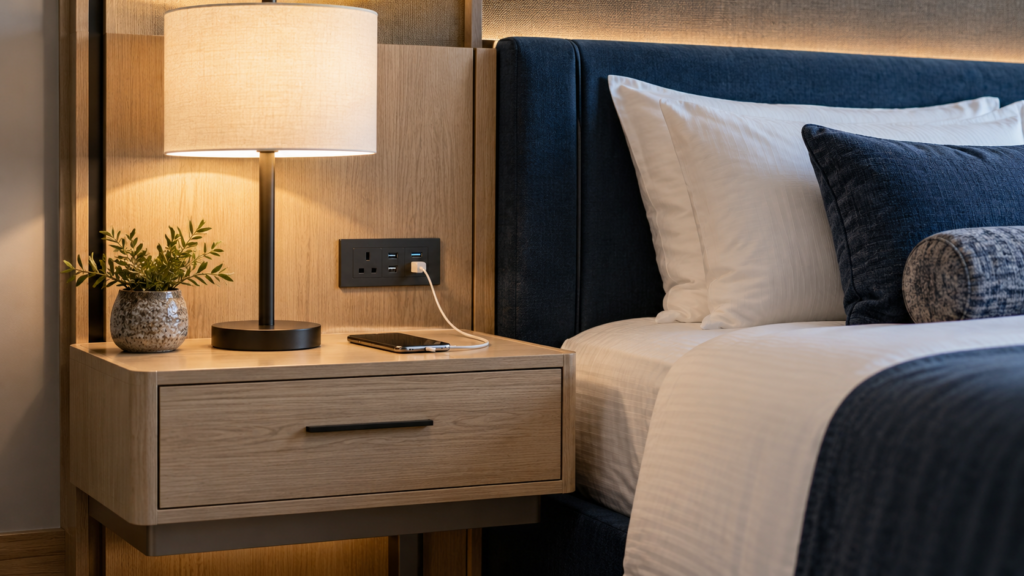
AI-generated design concept for this article, not a completed client project photograph.
What makes a useful hotel nightstand?
A useful hotel nightstand gives guests a convenient place for essentials while fitting the bed, lighting, electrical outlets, and housekeeping routine. Start with the room plan and actual guest activities, then decide which functions the nightstand should provide.
Position and access
Check both sides of the bed, the route around it, door swings, curtains, and whether drawers open fully. Record different requirements for twin, king, and accessible room layouts. Verify the final dimensions against the approved room drawing and installed bed.
| Review item | Question |
|---|---|
| Surface | Is there space for a lamp, phone, and personal items? |
| Storage | Is an open shelf, drawer, or both needed? |
| Power | Where will outlets and cables connect? |
| Cleaning | Can staff reach the floor and adjacent surfaces? |
| Coordination | Does the design align with the bed and headboard? |
Coordinate lighting and power
Decide whether lighting is wall mounted or placed on the cabinet. Coordinate outlet location and cable routes with the electrical designer and installer. The furniture supplier should receive drawings identifying penetrations and access; electrical work and compliance must be confirmed by the responsible local professionals.
Specify materials and details
Define the surface finish, edge profile, cabinet construction, drawer hardware, glides, and care instructions. Review a physical sample under the room’s lighting. If a drawer is included, test its travel and the clearance needed to use it.
Review a representative room
Place a sample beside the specified bed and headboard. Check lamp reach, drawer access, cable visibility, and housekeeping access. Record revisions by item code before repeating the design across the project.
Fictional planning example
This scenario is illustrative, not a completed client project. A 40-room hotel selects a compact nightstand with a drawer. A sample-room review identifies a conflict with a wall outlet, so the design team revises the cable opening and confirms the final electrical layout before production.
Frequently asked questions
Should every room have the same nightstand?
Use a common design where practical, but check each room type for space, bed configuration, and access requirements.
Can a nightstand contain outlets?
It can be designed around approved power components, subject to the electrical scope and applicable local requirements.
What should a buyer send for a quote?
Share room drawings, quantities, dimensions, finish references, storage needs, and the intended power and installation scope.
Start your furniture brief
Explore Simple Century furniture and contact the team with your room schedule. The indicative lead-time range is 15–45 days depending on the project; confirm the exact production, shipping, and installation schedule.