
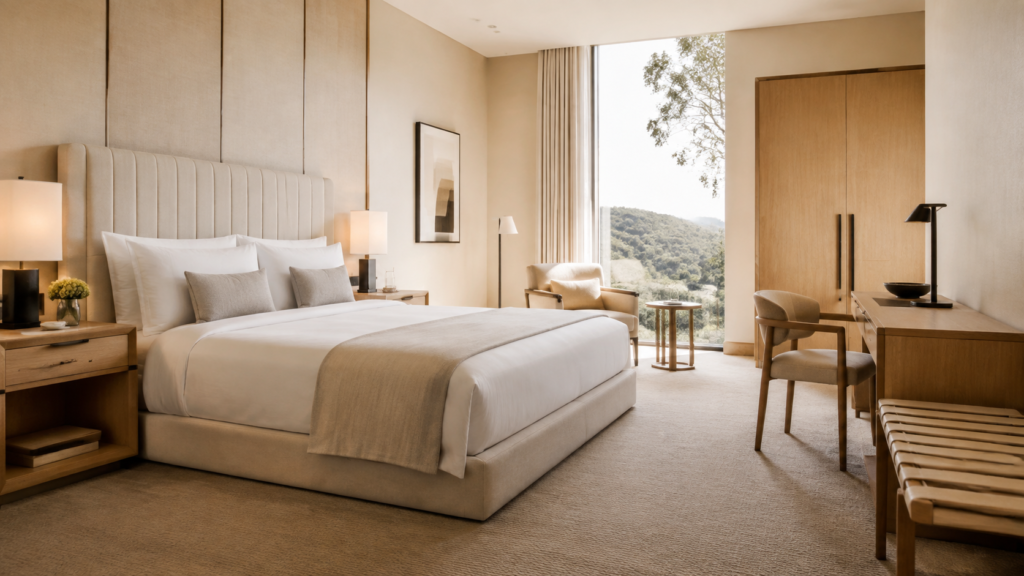
Hotel furniture procurement works best when the order begins with a room-by-room schedule, an agreed specification, and a documented sample approval. Compare suppliers against the same scope, then coordinate delivery with site access and installation readiness. A low furniture price is only useful when the delivered items fit the rooms and meet the approved requirements.
AI-generated design concept, not a completed client project. The room illustrates a coordinated furniture package.
What should a hotel furniture procurement schedule include?
A procurement schedule connects each furniture item to a room type, quantity, drawing, finish, and approval status. Give every item a unique code so that the quotation, sample, carton label, and installation plan refer to the same product.
FF&E means furniture, fixtures, and equipment. A furniture supplier’s quotation may cover only part of that wider package. Confirm whether decorative lighting, curtains, mattresses, mirrors, accessories, and installation are included or handled by other vendors.
| Schedule field | What to record | Why it matters |
|---|---|---|
| Location | Floor, room number, and room type | Keeps delivery and installation organized |
| Item code | A unique identifier for each specification | Prevents similar products being confused |
| Quantity | Units per room and total approved rooms | Makes changes traceable |
| Dimensions | Overall size and critical clearances | Connects the order to the actual space |
| Materials | Surface, substrate, upholstery, and hardware | Makes supplier quotations comparable |
| Approval | Drawing revision and sample reference | Identifies the version authorized for production |
For example, a proposed 24-room hotel with two bedside tables per room needs 48 bedside tables before any spares are added. This is an illustrative calculation, not a recommended spare allowance. Decide spare quantities by considering storage capacity, replacement lead time, and the consequences of a damaged item.
How do you turn a design concept into a usable specification?
Separate appearance from construction. “Warm oak look” describes a visual direction; it does not identify whether the item uses solid timber, veneer, or a decorative surface over a panel. Ask the supplier to describe the complete build, including edges, backs, internal surfaces, and hardware.
For headboards, coordinate the finished mattress height, wall interfaces, reading lights, and bedside controls. For wardrobes, check door movement, handle clearance, internal storage, and nearby equipment. Do not leave electrical interfaces to be resolved after furniture reaches the site.
Inspect the service route as well as the room. A desk can fit its final position yet fail to pass through a lift or turn on a staircase. Record the dimensions of packed or disassembled components when access is restricted.
What should be approved before bulk production?
Approve the drawing revision and the physical finish samples together. A sample approval should identify its item code, material, color, surface finish, and any accepted variation. Photographs are useful records, but lighting and screens can alter how a finish appears.
Where several pieces interact, review a representative room arrangement. Check bedside access, chair movement, luggage placement, cleaning access, and how doors and drawers open. Include housekeeping and maintenance staff in the review so that operational problems are found before repetition across every room.
Record each change in a single approval log. If the desk changes after the sample review, update the drawing and quotation rather than relying on a message that may not reach production.
How should hotel furniture quotations be compared?
Compare the same item codes, quantities, specifications, and delivery scope. List packaging, sample charges, inspection, freight, destination handling, storage, and installation separately where applicable. Ask who is responsible for each activity and which costs remain provisional.
An attractive total can hide a different substrate, fewer accessories, or excluded assembly. Request a written list of deviations from the specification before selecting a supplier. This makes it easier to distinguish a useful alternative from an incomplete offer.
What needs to happen before installation?
Confirm that rooms are ready to receive furniture and that the delivery route is available. Agree on carton labels, floor grouping, unloading arrangements, protective measures, and where packaging will be removed.
At handover, check quantities and condition against the schedule. Log missing parts, finish issues, and assembly defects by item code and room number, with photographs and an agreed resolution owner. Keep approved drawings and maintenance instructions for replacement orders.
Example brief: a city hotel with two room types
Fictional project scenario for illustration.
A fictional 24-room city hotel has 18 standard rooms and six larger rooms. The procurement team groups shared finishes into one palette but gives the larger desks separate item codes. Instead of asking for one general room price, it requests quantities and specifications by type. The scenario illustrates how a room schedule helps buyers compare offers; it does not describe an actual Simple Century contract.
Frequently asked questions
Should hotel furniture be ordered before room dimensions are final?
Budgeting and concept development can start earlier. Release dimension-sensitive items only after the relevant site dimensions and interfaces have been verified and approved.
Does a furniture quotation include the entire FF&E package?
Not necessarily. Define the included products and services explicitly, especially lighting, textiles, equipment, delivery, and installation.
What should I send when requesting a quotation?
Send room plans, room counts, an item schedule, reference images, finish preferences, the destination, and the required installation window. Identify any information that is still provisional.
Discuss your hotel furniture package
Simple Century’s website presents office and hotel furniture customization services. Explore its furniture range, then send your project requirements with room plans and an item schedule to discuss the scope of a quotation.
Simple Century’s stated lead-time range is 15–45 days, depending on the project. Ask for a project-specific schedule and confirmation of whether transport and installation are included.