
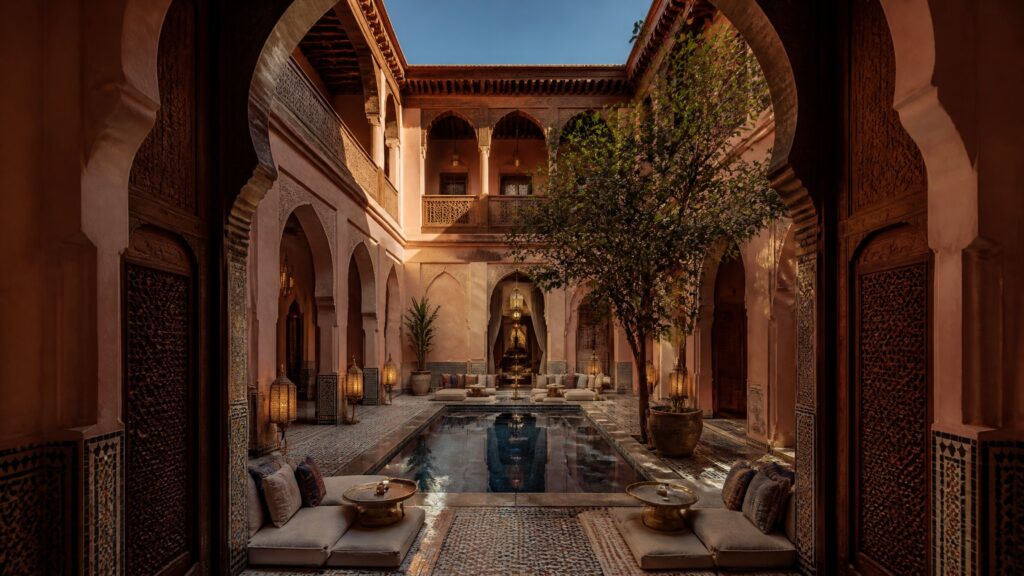
Marrakesh is a city built on atmosphere. Inside the ancient medina, behind unmarked doors, guests discover riads of carved cedar, zellige tile, and courtyards open to the sky. The demand for that experience has grown beyond the riads themselves: boutique hotels across the city now compete to interpret Moroccan craft for modern travelers. This case study examines how SimpleCentury brought Moroccan-inspired design into Marrakesh hotel interiors — a project where pattern, texture, and material culture had to be handled with genuine respect.
The client operated a boutique hotel near the medina walls, a property of arched corridors, tiled courtyards, and rooftop terraces facing the Atlas Mountains. The existing furniture was a mix of market finds and generic hotel pieces, and the owner wanted an interior with conviction: deep colors, rich textiles, carved details, and a sense that every object belonged. The challenge was to deliver that vision without losing months to custom projects with uncertain quality — which is exactly the problem our turnkey workflow is designed to solve.
SimpleCentury’s turnkey workflow gave the project a single spine: one design conversation, one production programme, one installation team. We began by documenting the property in detail — every alcove, every arch, every column — then developed a furnishing plan that combined new bespoke pieces with the selective restoration of the building’s character. Because design, manufacturing, and installation were managed together, decisions made in the design phase flowed directly into production without the usual reinterpretations and quality losses.
Production happened in our own factory, under the discipline of Strong Hand manufacturing. This is where the project’s reputation was built. Moroccan-inspired design lives in details — the depth of a carved panel, the precision of a lattice screen, the weight of a brass detail — and those details cannot be left to chance. Strong Hand manufacturing allowed us to produce carved headboards, turned table legs, and metalwork with consistent quality across every piece, using techniques that pair traditional proportions with modern structural engineering.
The palette was drawn from Marrakesh’s own materials: terracotta and sand tones from the ochre city walls, deep blues from the High Atlas, emerald greens from the palace gardens, and the warm glow of brass and bronze. Upholstery featured rich textures — woven wool, velvet, and hand-feel linens — while case goods combined dark stained woods with inlaid motifs inspired by zellige geometry. The layering of these textures is what makes a Marrakesh interior feel generous rather than merely decorated, and our designers controlled that layering down to the last cushion.
The furniture programme balanced spectacle with practicality. Guest rooms received carved headboards with integrated lighting, generous wardrobes with lattice doors, and seating designed for lounging as much as sitting. Courtyard furniture was specified for sun and evening damp, with powder-coated frames and outdoor-rated cushions in the same rich palette. The rooftop terrace was furnished with low seating around fire tables, framing the Atlas view. Every piece was drawn for its exact position in the building, so the interior reads as a single composition.
Small-batch customization was central to the economics of the project. A hotel of this scale does not need thousands of units; it needs dozens of carefully made ones, each correct in proportion and finish. We produced the programme in small-batch runs, which let the owner approve finish samples, refine the wood stain, and adjust a headboard design before the full run — without the cost of retooling a mass-production line. It also created an archive of the project’s specifications, so future additions or replacements can be manufactured to match exactly, even years later.
Delivery and installation were managed around the hotel’s rhythm. Furniture was shipped in a single, well-documented consignment, and our installation crew worked room by room, setting pieces according to the approved plan and handling the site adjustments that historic buildings always require. Stone floors and narrow staircases demanded careful logistics, and the team worked around occupied rooms where necessary. By the end of the installation, the building had been transformed without ever losing its architectural identity.
The results speak for themselves. Guests now photograph the interiors as much as the rooftop sunsets, and the hotel’s online reviews highlight the “Moroccan soul” of the rooms. The owner has since commissioned matching pieces for a new lounge, produced from the archived specifications in a new small-batch run — proof that the project continues to pay for itself. Perhaps most importantly, the craftsmanship has held up: the carved headboards and heavy textiles have absorbed two seasons of hospitality use without complaint.
This Marrakesh project shows what is possible when manufacturing discipline meets cultural inspiration. SimpleCentury delivered Moroccan-inspired hotel interiors that honor the medina’s craft traditions, executed through a turnkey workflow from our factory, built on Strong Hand manufacturing, and made possible by small-batch customization. For hoteliers who want the soul of Marrakesh without the chaos of a bespoke project, it is a proven path: design to manufacture, craft with control, and deliver with certainty.