
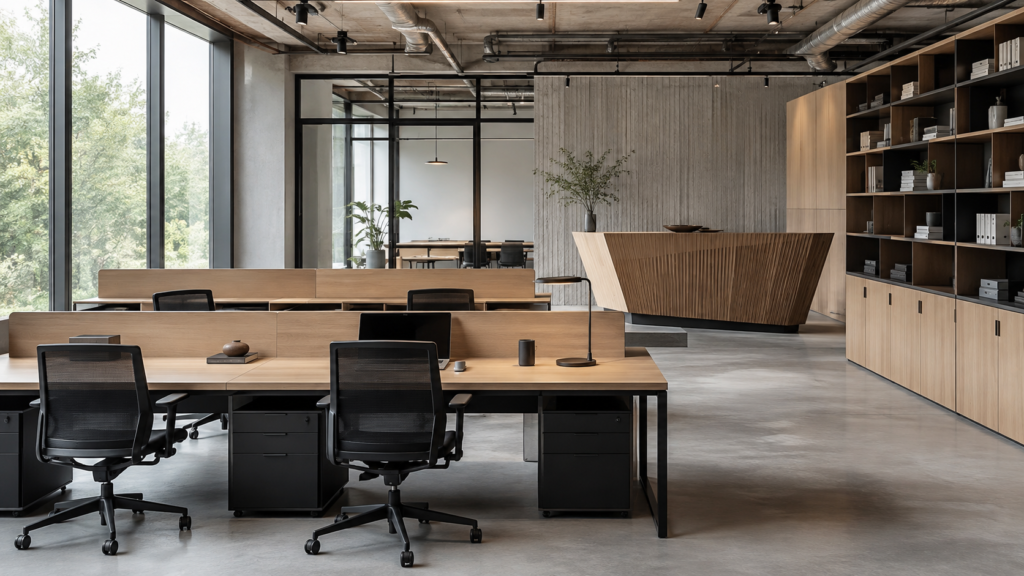
Choose custom office furniture when exact dimensions, unusual interfaces, or a distinctive design are central to the brief. Choose modular furniture when repeatability and future reconfiguration matter most. Many offices benefit from a mixed approach: standardize repeatable work areas and customize the pieces that solve a specific spatial or operational problem.
AI-generated design concept, not a completed client project. Repeated workstations and a distinctive reception counter illustrate a mixed furniture approach.
What is the difference between custom and modular furniture?
Custom furniture is produced to an agreed project specification. That can mean an entirely new design or a change to an existing product’s dimensions, materials, or details. Ask which elements are genuinely adjustable rather than assuming every component can be changed.
Modular furniture uses components designed to work within a defined system. Reconfiguration depends on that system’s connections, dimensions, and available parts. The word “modular” does not mean every component can be reused in every future layout.
| Decision factor | Custom furniture | Modular furniture |
|---|---|---|
| Fit | Can address a specific room or interface | Fits within available system dimensions |
| Visual identity | Offers project-specific details | Creates consistency through repeated components |
| Reconfiguration | Depends on how the piece is designed | Depends on system compatibility and parts supply |
| Procurement | Requires clear drawings and approvals | Requires a clear configuration and component list |
| Future orders | Need retained specifications and material availability | Need continued system and finish availability |
| Cost | Depends on complexity, quantity, and scope | Depends on configuration, accessories, and scope |
Neither option has a universal price or lead-time advantage. Compare real proposals for the same functional requirement.
Where does custom office furniture add the most value?
Customization is useful when a standard item leaves a meaningful problem unresolved. Examples include a reception desk that must accommodate particular equipment, storage fitted around structural columns, or a meeting table coordinated with room geometry and audiovisual equipment.
Start by defining the problem in measurable terms. “Premium boardroom” is a design ambition; “all participants must have a usable view of the display and access to the specified power modules” is a requirement that can be reviewed.
Check how a custom piece reaches the room. A long table may need a sectional top or a base that can be assembled on site. Record access constraints before approving the construction.
When is modular office furniture the practical choice?
Consider modular furniture when teams are likely to change size, desks repeat across a floor, or facilities staff need a consistent kit of components. Ask the supplier to demonstrate the intended reconfiguration, including any additional parts required.
Check whether screens, storage, cable management, and replacement tops remain compatible when the layout changes. A desk system that looks flexible in a catalogue can become difficult to adapt if essential components are proprietary or unavailable.
For a phased office, request a component schedule and discuss future supply. Retain finish samples, but allow for possible batch variation and product changes instead of assuming an exact match will always remain available.
How can a mixed approach work?
Use custom and modular pieces according to function rather than job title. A reception counter may need customization because of visitor flow and equipment, while an executive office may work well with standard components.
As an illustrative planning exercise, consider a workplace with 40 repeated workstations, two meeting rooms, and one reception area. Evaluate the workstations as a repeatable system. Review each meeting room against its occupancy and equipment. Customize the reception counter only where standard options do not satisfy the brief. These numbers describe an example, not a space-planning standard.
Maintain a shared finish palette and a coordinated height strategy where pieces sit together. Consistency can come from materials and proportions even when products use different construction systems.
What should you compare before approving an order?
Ask each bidder to price the same layout and list its assumptions. Include accessories, delivery, assembly, and any work needed to modify the furniture later. Separate furniture scope from electrical and data work so that the handover responsibilities remain clear.
Review a representative workstation or meeting setup with intended users. Check equipment fit, chair movement, storage access, cable access, and cleaning. A practical review is more informative than selecting solely from an image.
Frequently asked questions
Is custom furniture always more expensive?
No fixed rule applies. Design complexity, quantity, finishes, hardware, and delivery scope all affect the comparison. Obtain like-for-like quotations.
Can custom furniture be designed for future moves?
Yes, if disassembly, transport, and reassembly are included in the brief. Confirm the joints, replaceable parts, and limits of the design before production.
What should I ask a modular furniture supplier?
Ask for the component list, compatible configurations, assembly requirements, replacement-part policy, and any limitations on future expansion.
Plan a furniture package around your workplace
Review Simple Century’s furniture offering and discuss your office layout. Include your current team requirements, expected changes, room plans, and equipment needs so that proposed furniture can be assessed against the way the space will operate.
Simple Century’s stated lead-time range is 15–45 days, depending on the project. Ask for a project-specific schedule and confirmation of whether transport and installation are included.