
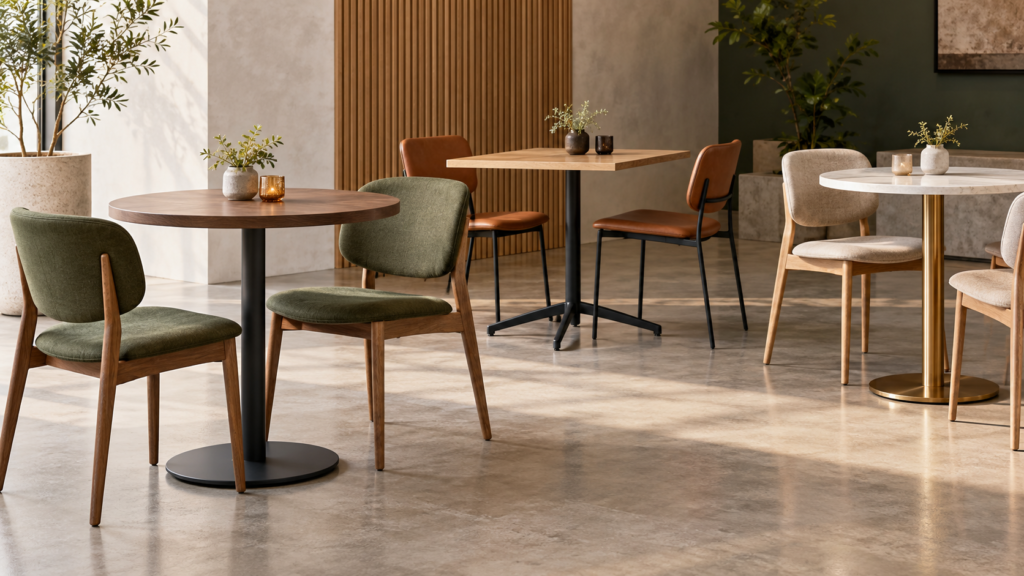
AI-generated design concept for this article, not a completed client project photograph.
How should buyers select a cafe table base?
Cafe table base selection should assess the complete table: top, base, connections, floor contact, and intended use. A base that looks suitable beside one top is not automatically appropriate for a different size, shape, material, or application. Ask the supplier to confirm the proposed combination.
Start with the actual tabletop specification and dining arrangement. Include the chairs, guest positions, table setting, cleaning routine, and whether staff will move the tables regularly. Those details help define what the assembly needs to do.
Confirm top and base compatibility
Record the tabletop dimensions, material, construction, edge detail, and mounting arrangement. Ask the supplier to identify the base model and confirm the assembly it proposes for that top. Review the connection details and any stated use limitations.
| Comparison area | Question to resolve |
|---|---|
| Compatibility | Is the exact top-and-base combination accepted by the supplier? |
| Legroom | Where are the base and supports relative to seated guests? |
| Floor contact | How does the assembly accommodate the actual floor condition? |
| Operation | Can staff move, combine, or store tables as planned? |
| Maintenance | Which fasteners, glides, and components can be serviced? |
Review chairs and guest positions
Place the intended chairs around a representative table. Check foot positions, chair movement, and the relationship between table supports and guests’ legs. A pedestal, cross base, or four-leg base creates different contact points; evaluate the actual geometry rather than choosing from a style label.
Where tables will be placed together, review the combined arrangement as well. Confirm alignment, chair positions, floor contact, and the operator’s method for changing layouts. Do not assume that matching tabletop heights alone make every combination practical.
Ask for relevant stability information
Describe the intended environment and use to the supplier. Request information relevant to the proposed assembly and clarify what any supplied evidence covers. An image or the apparent weight of a base does not establish the stability of the finished table.
If the table rocks, identify whether the issue relates to the floor, adjustment, assembly, or product condition before choosing a remedy. Follow the supplier’s installation and service guidance rather than making an unapproved modification.
Include cleaning and handling in the decision
Review access around the base and the proposed finish’s care requirements. Confirm how staff should move the table and whether repeated moves affect fasteners or floor-contact components. Keep replacement references for glides and other serviceable parts.
For outdoor or partly exposed locations, specify the actual environment and request an appropriate proposal. Do not assume an indoor table is suitable for exterior use because it has a coated metal base.
Fictional planning example
Fictional scenario for illustration, not a completed Simple Century client project. A cafe compares two base options under the same square top. A sample review reveals different chair clearances, so the operator chooses only after checking guest positions, floor contact, and the intended paired-table arrangement.
Frequently asked questions
Is a pedestal base always better for legroom?
No. The footprint, support shape, chair positions, and tabletop configuration determine the usable space.
Can a tabletop be changed while retaining the old base?
Ask the supplier to assess the new top, connection, and intended use before assuming compatibility.
Should cafes order bases and tops separately?
They can be sourced separately, but responsibility for confirming the complete assembly must remain clear.
Request a complete-table proposal
Review Simple Century’s furniture range and share your cafe table brief. Confirm available options and a project-specific schedule within the stated 15–45-day range.