
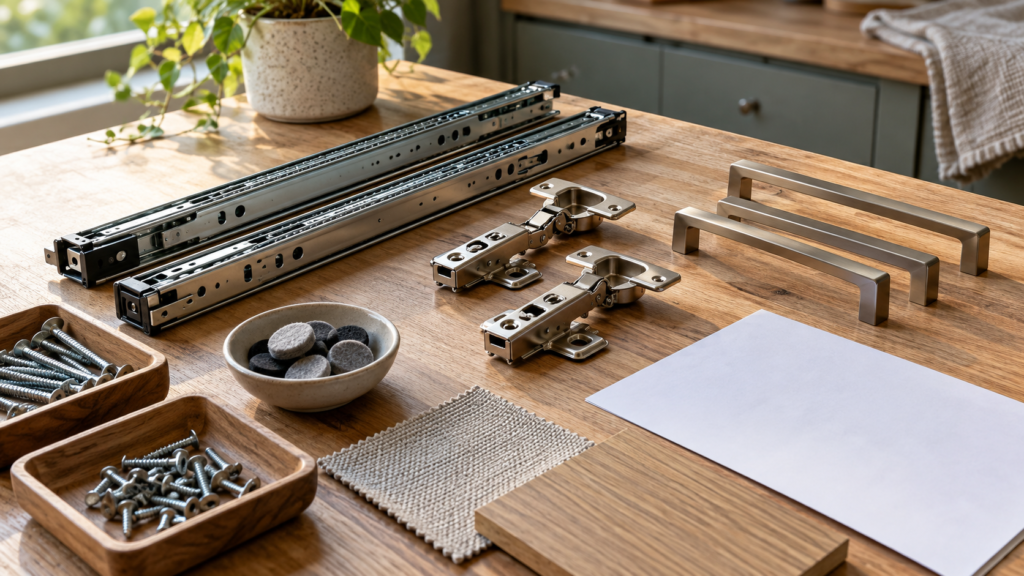
AI-generated illustrative furniture concept, not a completed client project photograph.
What is furniture spare parts planning?
Furniture spare parts planning identifies which components can be replaced, how they are specified, where they will be stored, and who can obtain or install them. Establishing this information during procurement makes later maintenance decisions easier.
Begin with the actual furniture construction and operating environment. A hotel bedroom, a restaurant, and an office have different use patterns. There is no single spare-parts quantity that suits every package.
Identify serviceable components
Ask the supplier which parts can be replaced independently: hinges, drawer runners, handles, glides, upholstery covers, cushions, panels, or other components. Confirm whether removal requires special tools, trained personnel, or partial disassembly.
For each proposed spare, record the product reference, location in the furniture, compatible item code, finish, dimensions where relevant, and installation instructions. A photograph helps identification but should accompany a defined reference.
| Record | Why it helps |
|---|---|
| Furniture item code | Links the spare to the correct product |
| Component reference | Distinguishes similar-looking hardware |
| Drawing revision | Shows the approved construction |
| Finish or covering code | Supports comparison during replacement |
| Supply information | Records availability assumptions and reorder process |
Choose spares according to operational need
Discuss which failures would put a room or workstation out of use and how quickly a replacement could be supplied. Consider local storage, the value of the component, expected handling, and the supplier’s actual availability information.
Ask for a proposed spare list with reasons for inclusion. Avoid ordering a fixed percentage of every component simply because it is easy to calculate. Some parts may be easy to source later, while a distinctive covering or proprietary fitting may require more planning.
Keep finish and batch records
Retain approved samples and finish references with the purchase records. A future replacement may differ because materials, production batches, or product designs change. Confirm compatibility and appearance at the time of reorder.
Where a replacement affects several visible pieces, review them together before deciding whether to replace one component or a coordinated set. The operator can then balance appearance, downtime, and cost using the actual proposal.
Store parts so they remain usable
Label stored components and follow the supplier’s storage guidance. Keep hardware packs with their references and protect fabric or finish samples from conditions that could alter them. Record issues and withdrawals so the spare list remains current.
Assign a person or team to maintain the furniture register. Include room or area location, installation date, service history, and the supplier contact used for reorders. Keep the register accessible to procurement and facilities staff.
Fictional planning scenario
This is a fictional planning example, not a completed Simple Century client project. An office buyer creates a register for desks and storage units. The supplier identifies compatible drawer runners and handles, while facilities staff record which units use each fitting. Later maintenance requests can refer to a component code instead of relying on a description such as “the silver handle.”
Frequently asked questions
Should buyers order spare furniture or spare components?
Consider both according to downtime, repair access, storage space, and supply conditions. A component is useful only when it can be installed practically.
Will the same part always remain available?
Do not assume continued supply. Ask about current availability and alternatives, and reconfirm compatibility when placing a reorder.
What information should be retained at handover?
Keep drawings, item codes, component references, approved finishes, care instructions, assembly information, and the agreed replacement process.
Plan maintenance with the original order
Explore Simple Century’s furniture range and discuss spare parts for your project. Confirm component availability individually. The stated 15–45-day project lead-time range is subject to project-specific confirmation and should not be treated as an automatic spare-parts delivery promise.