
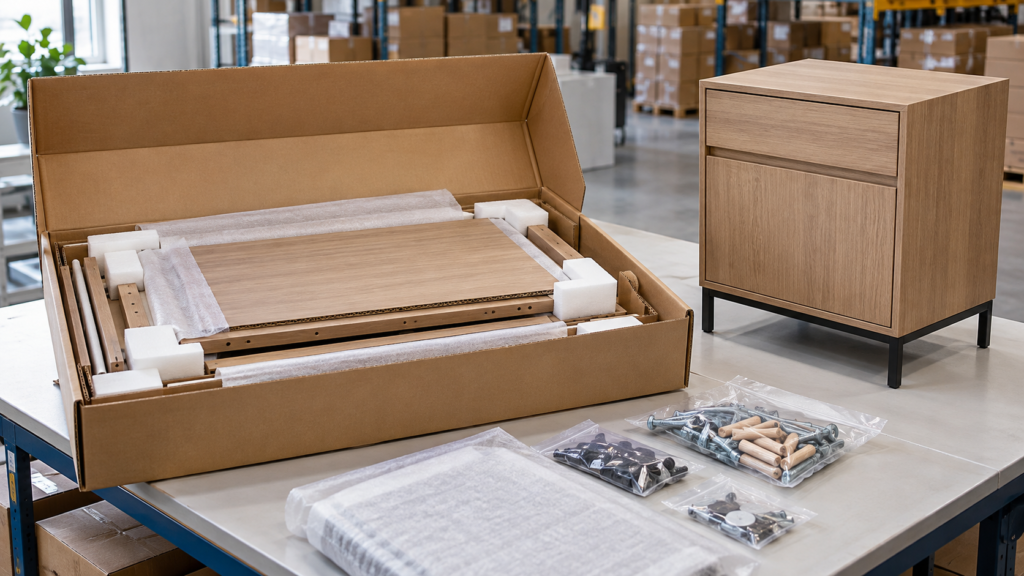
AI-generated illustrative furniture concept, not a completed client project photograph.
What should commercial furniture packaging achieve?
Commercial furniture packaging should protect the specified product through the agreed transport and handling route, keep components identifiable, and support controlled unpacking at the destination. Buyers should review packaging as part of the furniture proposal rather than treating it as a detail decided at dispatch.
Begin with the destination, transport scope, unloading arrangements, storage conditions, and assembly plan. A packaging proposal can only be assessed against the route and handling assumptions it is intended to cover.
Match protection to the item
Ask how exposed edges, corners, coated surfaces, upholstered areas, glass or other fragile components, and loose hardware will be protected. Record whether pieces travel assembled or in sections and how movement within the pack is controlled.
If a supplier provides packaging test information, confirm the item, pack configuration, method, and conditions it covers. Do not infer a guarantee for every transport route from a general test statement.
| Packaging area | Buyer review point |
|---|---|
| Surface protection | Compatibility with the actual finish and unpacking method |
| Corners and edges | Protection for vulnerable geometry |
| Hardware | Separate identification and connection to assembly drawings |
| Carton information | Item code, pack number, and handling information |
| Receiving | Condition checks and the agreed issue-reporting process |
Use labels that connect to the order
Keep item codes consistent across the purchase schedule, drawings, packing list, and carton labels. For an item shipped in multiple packs, show the relationship between them. When room allocation is required, agree whether labels identify room types, areas, or individual room numbers.
Avoid placing confidential guest or personal information on labels. Ordinary project item codes and area references are usually enough for furniture identification.
Plan unpacking and assembly
Ask where unpacking should occur and how staff can open the packaging without damaging the product. Identify which materials must remain until inspection and which hardware packs belong to each assembly. Include unpacking and waste-removal responsibilities in the site scope.
Retain care and assembly instructions with the received items. If furniture will be stored before installation, agree the storage conditions and how the condition of the goods will be recorded at receipt and release.
Agree inspection before delivery
Define who receives the shipment, what visible condition checks are performed, and how missing packs or damage are reported. Link photographs to item and pack codes. Confirm the reporting process and relevant time limits in the agreed order terms rather than inventing a universal rule.
Fictional planning scenario
This is a fictional planning example, not a completed Simple Century client project. A buyer orders desks and wardrobes for a serviced-apartment project. Each wardrobe has several packs, so the team agrees linked pack numbers and stores the hardware with its matching unit. The packing list then supports both receiving and room allocation.
Frequently asked questions
Is flat-pack delivery always preferable?
No. Compare access, protection, assembly work, joint design, and handling. The best format depends on the product and project.
Should the buyer request packaging photographs?
Photographs can support a review, but they should be linked to the actual item and packaging specification rather than used as the only evidence.
Does a production lead time include shipping?
Do not assume it does. Confirm dispatch, transport, arrival, and installation scope separately.
Include packaging in your enquiry
Review Simple Century’s furniture offering and share your delivery requirements. The stated lead-time range is 15–45 days depending on the project; packaging and transport requirements must be included in the project-specific schedule assessment.