
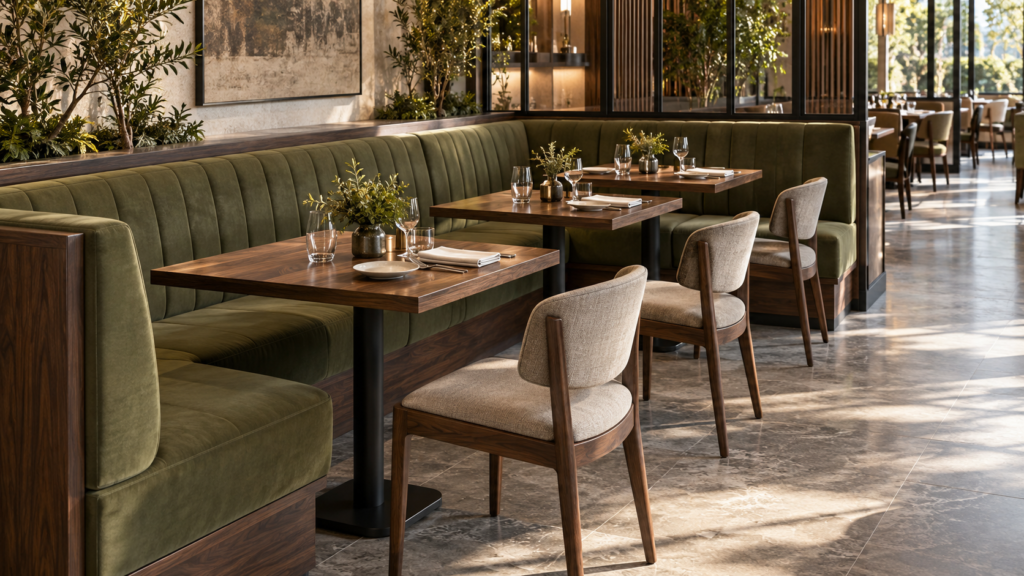
AI-generated design concept for this article, not a completed client project photograph.
How should a restaurant banquette be designed?
Restaurant banquette seating design should begin with the seating position, table relationship, guest access, and cleaning routine. Establish those requirements on a verified room plan before finalizing upholstery or decorative details. A banquette’s value depends on how it works with the whole dining setting.
Distinguish a built-in unit from a freestanding or sectional arrangement. The mounting, measuring, delivery, and future removal responsibilities may differ. Confirm which approach the supplier is pricing and how it interfaces with walls, columns, flooring, and services.
Review the banquette with its actual table
Assess seat-to-table relationships, base position, access to the inner seating positions, and movement at corners. The seat and table dimensions need to be reviewed together. Do not infer a seating count solely from a long bench outline.
| Design decision | Review requirement |
|---|---|
| Straight seating | Usable sitting positions with the intended tables |
| Corner seating | Practical guest access and table reach |
| Table base | Legroom and clearance at entry points |
| Upholstery | Covering reference, seams, and replacement approach |
| Installation | Section sizes, joints, fixing, and site access |
Verify the architectural interfaces
Use measured dimensions and record the drawing revision. Include skirting, columns, wall finishes, outlets, and other fixed elements that affect the furniture. Where the unit follows an irregular wall or a curve, agree how the geometry will be confirmed before production.
Have the design team coordinate the arrangement with the approved circulation and accessibility plan. A banquette may change how guests enter a dining position and how staff approach a table; test both activities in the layout review.
Specify upholstery for the operating brief
Record the covering reference, seam layout, support construction, and care method. Ask whether cushions, covers, or upholstered panels can be replaced independently. Confirm how staff can access those components after installation.
Discuss spills, crumbs, cleaning equipment, and the operator’s maintenance routine. A seam detail that looks attractive in a sample may create an awkward cleaning location when repeated beside every table. Ask for an assembly sample or representative section where the detail is important.
Plan delivery in sections
Check the route from unloading to the final location. Sectional construction can help with access, but the joints and fixing arrangements must be part of the approved design. Identify who measures, assembles, fixes, protects adjacent finishes, and removes packaging.
Keep finish references, component drawings, and installation information with the handover records. Those records help future repairs even though material availability and exact visual matching still require confirmation at the time of replacement.
Fictional planning example
Fictional scenario for illustration, not a completed Simple Century client project. A restaurant proposes an L-shaped banquette around a column. The team reviews a corner section with the selected table base, adjusts the guest entry point, and agrees sectional joints that fit the delivery route.
Frequently asked questions
Does banquette seating always create more seats?
No universal increase applies. The usable count depends on table placement, guest access, room geometry, and the approved circulation plan.
Can banquette cushions be replaced later?
That depends on the construction. Include replacement access and component references in the specification before ordering.
What should buyers provide for a quotation?
Send the verified plan, desired configuration, proposed tables, finish direction, quantities or lengths, and installation responsibilities.
Develop a banquette brief
Explore Simple Century’s furniture offering and share your restaurant layout. Confirm available options and the project-specific schedule within the stated 15–45-day range, including approval and delivery assumptions.