
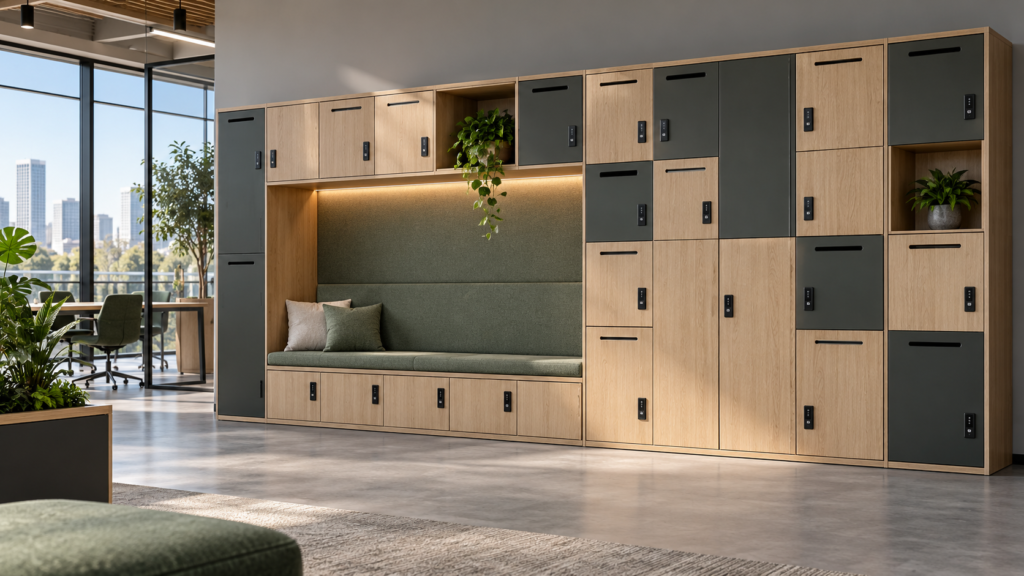
Office locker planning begins with the belongings people need to store and how often they need access. Size compartments and circulation space around real use rather than choosing a cabinet solely by its appearance.
Estimate capacity
Ask whether users need space for a laptop, bag, coat, helmet, or deliveries. Compare assigned lockers with shared lockers for flexible workplaces. Build a quantity schedule that includes any agreed spare capacity and future changes.
Choose the location
Place lockers near the activities they support without blocking doors or circulation. Allow people to open a door and retrieve items while colleagues pass. Check wall conditions, skirting, outlets, and any required anchorage with the project team.
Compare locking systems
| Lock type | Consideration | Operational question |
|---|---|---|
| Mechanical key | Simple daily operation | How will lost keys be replaced? |
| Combination | No physical key to carry | Who manages forgotten codes? |
| Electronic | Can support shared allocation | How are power and access managed? |
Specify construction and finishes
Review the thickness and construction of shelves, door hinges, ventilation needs, and cleanable surfaces. Ask for a sample to check door operation, compartment dimensions, and the chosen finish. The supplier should confirm anchoring and service access in the final drawings.
Illustrative example
A fictional flexible office tests a locker prototype with common laptop bags and discovers that the original opening is too narrow. The design team changes the clear opening before production. This is an illustrative scenario.
Plan delivery
Custom furniture may take 15–45 days, depending on specifications, volume, materials, and approvals. Agree the date for the specific project. Send a floor plan and storage requirements to Simple Century.
Frequently asked questions
How large should a locker be?
Measure representative belongings, including the largest typical bag, and allow room for easy insertion and removal.
Are lockers suitable for shared offices?
Yes, if allocation, access, cleaning, and the process for forgotten belongings are agreed with the operator.
What should be checked before production?
Review compartment dimensions, lock operation, finish samples, fixing details, and site clearances.