
Simple Century’s stated custom furniture lead-time range is 15–45 days, with the exact schedule confirmed for each project. Before relying on a date, confirm what starts the clock, which activities the quotation includes, and whether transport and site installation fall within that schedule. The range is a planning reference, not an unconditional arrival guarantee.
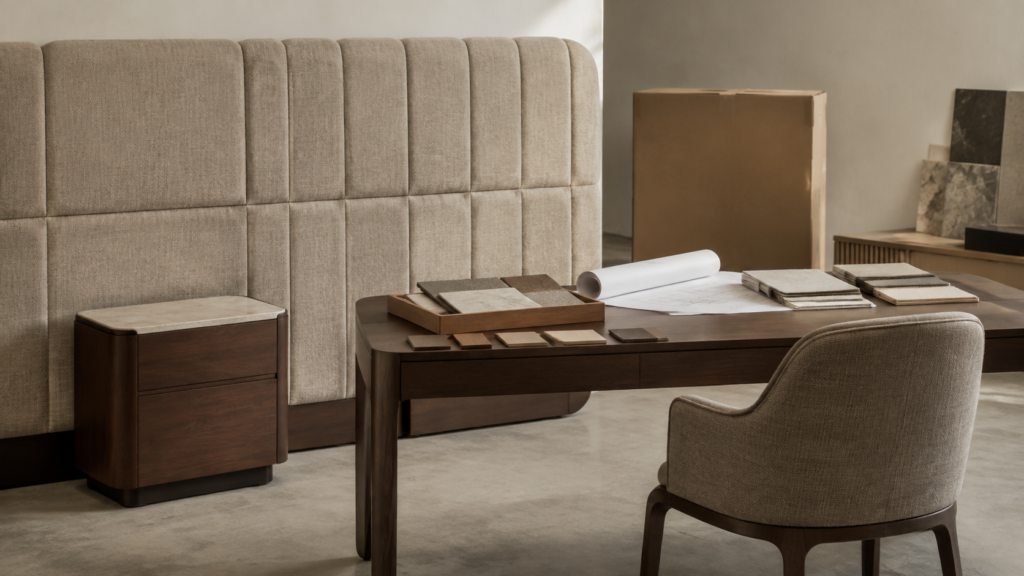
AI-generated sample-review concept, not a photograph of the Simple Century factory. Drawings and finish samples illustrate preproduction coordination.
What does a furniture lead time actually cover?
The phrase “lead time” is useful only when its beginning and end are defined. A supplier may discuss a period ending when goods are ready for dispatch, while a buyer is thinking about the day installed rooms can open. Put the agreed milestone in writing.
For a Simple Century proposal, ask how the 15–45-day range applies to the specific order. Clarify the treatment of design development, samples, production, inspection, shipping, and installation. Confirm whether the quoted days are calendar or working days and which approvals or other agreed conditions must be complete before the schedule begins.
| Stage | Information needed | Decision to record |
|---|---|---|
| Brief | Plans, quantities, item list, destination | Whether the scope is ready for quotation |
| Drawings | Verified dimensions and interfaces | Which revision is approved |
| Samples | Finish references and prototype requirements | What is accepted for production |
| Manufacture | Final specification and agreed changes | Project-specific completion milestone |
| Inspection | Agreed checks and issue reporting | Whether outstanding items are resolved |
| Delivery | Shipping scope, access, and site readiness | Dispatch, arrival, and installation responsibilities |
What can change the project schedule?
Quantity is only one part of the assessment. Several repeated items may require a different workflow from a small order containing many unique designs. Materials, hardware availability, finish development, sample revisions, and packing requirements can also affect the plan.
A late dimensional change can reach beyond one drawing. It may alter the structure, material requirement, packaging, or delivery method. Ask the supplier to assess the schedule impact before authorizing the change rather than assuming the original date remains valid.
Site readiness matters as well. If furniture is completed but the receiving rooms or unloading arrangements are unavailable, the project still needs a storage and delivery decision. Coordinate the supplier’s milestones with the building team’s programme.
Example project: a boutique hotel’s phased room refresh
The following is a fictional planning scenario, not a completed Simple Century client project.
Consider a 30-room boutique hotel replacing headboards, bedside tables, and desks while keeping part of the property operating. The owner provides three room types and requests phased deliveries. The planning challenge is to connect each batch to available rooms and protect an uninterrupted guest route.
The buyer prepares one item schedule, approves a representative finish set, and identifies which room types require different dimensions. The supplier is then asked to confirm an achievable project schedule within the stated 15–45-day range, including the scope and timing of each phase. No delivery date is treated as agreed until the proposal addresses those details.
This example illustrates why a room count alone cannot establish a lead time. Room variation, approval readiness, and the requested delivery sequence all need to be included in the brief.
How can buyers keep approvals moving?
Nominate one person to consolidate comments from design, procurement, and operations. Ask reviewers to work from the same drawing revision and sample references. Conflicting instructions are easier to prevent than to correct after production starts.
Maintain a short decision log showing the open question, responsible person, required decision, and schedule consequence. Review unresolved equipment interfaces and dimensions early. When an item is approved, identify exactly what that approval covers and what remains outstanding.
Where a material alternative is proposed, assess appearance, construction, maintenance, price, and timing together. A faster substitute is only useful if it remains suitable for the project and receives the necessary approval.
What should you confirm before accepting a delivery date?
Request a written schedule with the starting conditions, completion milestone, and included services. Make the destination and access constraints visible in the enquiry. Agree how changes, inspection issues, and a delayed site handover will be communicated.
Keep dispatch, arrival, and installation as distinct milestones when they are distinct services. This makes the programme easier to coordinate and prevents a factory completion date from being mistaken for an opening-ready date.
Frequently asked questions
What is Simple Century’s custom furniture lead time?
The stated range is 15–45 days. The exact lead time and included scope are confirmed for the specific project.
Does the range automatically include international shipping?
Do not assume that it does. Ask the quotation to identify transport, arrival, and installation scope explicitly.
Can every order be completed in 15 days?
No universal 15-day commitment is stated. Feasibility depends on the project and must be confirmed before the schedule is accepted.
Request a project-specific timeline
Contact Simple Century with the item list, quantities, room plans, finish direction, destination, and target milestone. Mention whether you need dispatch, arrival, or completed installation by that date so the proposal can address the right requirement. You can also review the furniture range when preparing your brief.