
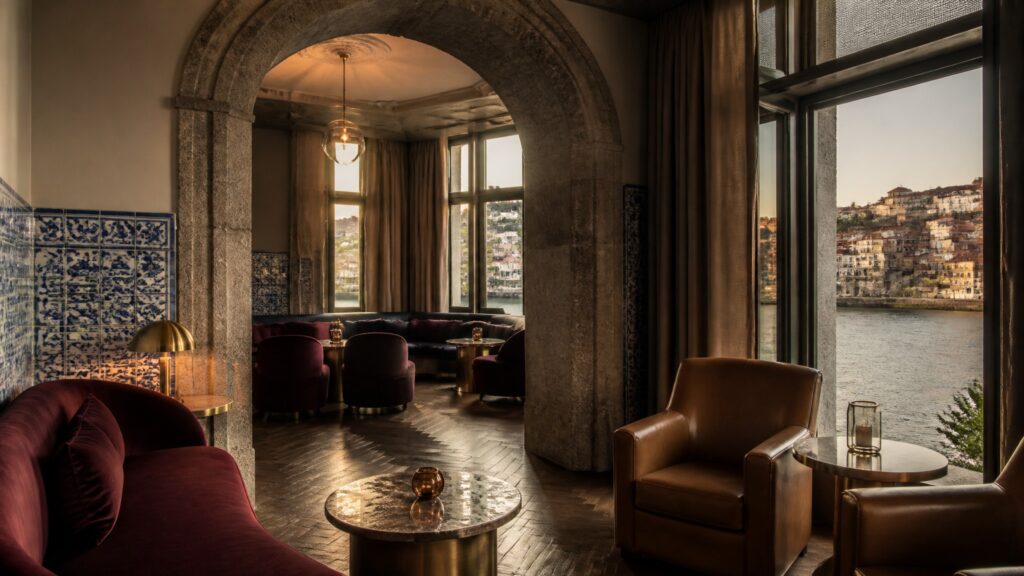
Porto rises in terraces above the Douro River, a city of granite, azulejo tiles, port wine lodges, and bridges that frame one of Europe’s most cinematic skylines. The riverside district of Ribeira draws travelers who want atmosphere, not anonymity, which is why the city’s boutique hotel scene has flourished. This case study looks at how SimpleCentury furnished a riverside boutique hotel interior in Porto — a project that demanded authenticity, craftsmanship, and a delivery model built for hospitality timelines.
The brief came from an operator converting a historic riverside building into a small luxury hotel. The structure itself was part of the story: thick stone walls, timber beams, and irregular floor plates that no standard furniture plan could accommodate. The owner wanted guests to feel the Douro in every room — the blue-green of the water, the amber of aged port, the texture of local stone and cork. That ambition ruled out a catalogue approach from the start, and it is precisely where our turnkey workflow excels: one team, one plan, one accountable result.
Hospitality projects are unforgiving about dates. A hotel loses revenue for every week it stays closed, so the furnishing programme had to be designed, manufactured, shipped, and installed inside a hard schedule. Our turnkey workflow compressed the traditional sequence: we surveyed the building, produced detailed drawings, and moved directly into fabrication at the factory. There was no third-party contractor chain to coordinate, no mismatch between drawings and delivered goods, and no guesswork about who owned a problem when it appeared. That single-point responsibility was the foundation of the whole delivery.
The manufacturing power behind the project was Strong Hand manufacturing. Every bespoke piece — the hand-finished reception console, the river-facing banquettes, the solid timber bed frames, the wardrobe joinery — was produced on our own lines. Strong Hand manufacturing allowed us to prototype finishes, test structural details, and correct issues before anything left the factory. For a boutique hotel where every piece is photographed by guests and reviewed on travel platforms, that level of control over finish quality is not a luxury; it is the business model.
Materials were chosen to tell the Douro story. We used cork panels as acoustic and decorative surfaces, a material with deep roots in Portuguese design and exceptional acoustic performance for intimate hotel corridors. Oak was specified for floors and case goods, with a finish that echoes the barrels of the port lodges downstream. Textiles drew on the palette of the river: deep greens, slate blues, warm amber, and the crisp white of the azulejo tradition. Local stone details appeared in bathrooms and lobby accents, connecting the interior to the city outside.
Boutique hotels succeed on character, and character lives in the details. Guest rooms were fitted with custom headboards incorporating integrated reading lights and bedside controls, designed around the exact dimensions of each room. Public spaces received made-to-measure seating that could handle both breakfast service and evening drinks. Corridors were lined with art walls and concealed storage, so the historic character of the building was never diluted by modern clutter. Every element was drawn specifically for this building, in this city, on this river.
Because the hotel is small and the design language highly specific, the production strategy leaned on small-batch customization. Instead of tooling up for mass production, we manufactured in precise runs matched to the room count — a handful of bed types, a limited family of case goods, a suite of public-area pieces — with the engineering data retained for future phases. When the operator later expanded into an adjacent floor and requested matching furniture, a new small-batch run reproduced the originals exactly, including the aged-looking finishes that give the interiors their sense of permanence.
Installation was managed as a choreographed sequence. Because the riverside location limits street access, deliveries were timed around the building’s service windows, and the furniture was designed for assembly in tight spaces — modular beds, sectional banquettes, and case goods that could be carried up the historic staircase and assembled in situ. Our installation crew worked alongside the hotel’s own finishing teams, and the entire interior was commissioned two days ahead of the soft-opening date, with every piece placed according to the approved plan.
The result is a hotel where guests arrive expecting the romance of Porto and find it in the details: the way morning light moves across the cork-lined wall, the solidity of the oak wardrobe, the comfort of a banquette built exactly for the depth of the window alcove. The operator’s reviews now regularly mention the interiors as a reason to return, and occupancy has supported the expansion into the adjacent floor — furnished, as promised, by a matching small-batch run.
This project is a clear example of what SimpleCentury does best: a boutique hotel interior in Porto that honors its riverside setting, delivered through a turnkey workflow, manufactured by Strong Hand manufacturing, and kept flexible through small-batch customization. From the first site survey to the final nightstand, the entire journey was designed, built, and installed as one continuous process — proof that authenticity and efficiency can share the same building, and the same deadline.